
TAJIKISTAN’S INITIATIVE ON THE INTERNATIONAL STAGE: ARTIFICIAL INTELLIGENCE FOR SUSTAINABLE DEVELOPMENT
In the history of international relations, certain initiatives mark the beginning of a new stage of global cooperation. Tajikistan’s initiative in the field of artificial intelligence is among such important undertakings.
The significance of this initiative lies, first and foremost, in the fact that the issue of artificial intelligence, at the initiative of the President of the Republic of Tajikistan, Leader of the Nation, His Excellency Emomali Rahmon, was elevated to a prominent place on the international agenda.
Today, artificial intelligence is transforming various areas of human life at an unprecedented pace. It can contribute to the advancement of science, education, healthcare, the economy, energy, agriculture, public administration, and environmental protection. At the same time, it raises important issues related to data protection, cybersecurity, technological responsibility, and equitable access to technology.
Therefore, the central question is not merely “How should we develop artificial intelligence?” but rather “How can we use it for the benefit of humanity and the sustainable development of society?”
It is precisely in this context that Tajikistan’s initiative acquires particular significance. It demonstrates that developing countries should also contribute to shaping new technological standards and processes. Artificial intelligence should become an instrument for inclusive development and the reduction of the digital divide.
For Tajikistan, artificial intelligence can be applied in key areas of national importance, including water resource management, glacier and climate change monitoring, energy, agriculture, economic forecasting, public services, and education.
However, technology alone is not sufficient to make effective use of these opportunities.
Therefore, the training of specialists in artificial intelligence, machine learning, data analytics, robotics, programming, and cybersecurity should become one of the priority areas of national development. Universities and research centers should not merely remain users of ready-made technologies, but should become environments for the research, development, and creation of national technological solutions.
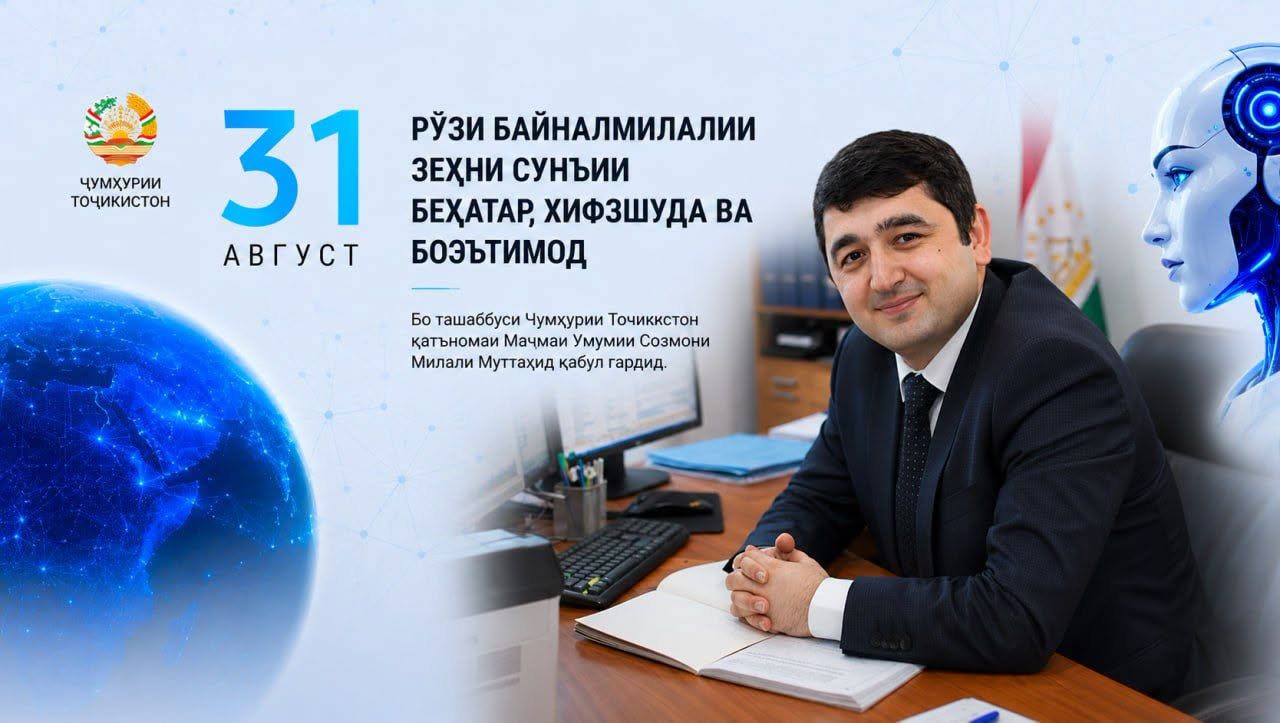
The date of 31 August 2026 was recorded as an important milestone in the history of international cooperation in the field of emerging technologies. At the initiative of the President of the Republic of Tajikistan, Leader of the Nation, His Excellency Emomali Rahmon, 31 August was recognized at the United Nations level as the International Day of Artificial Intelligence.
This decision is more than the designation of a new date. It represents recognition of the growing importance of artificial intelligence in the advancement of science, technology, the digital economy, and modern society.
For Tajikistan, this event is of particular historical significance, as the initiative proposed by the Leader of the Nation developed into an undertaking of global importance. It demonstrates Tajikistan’s active participation in shaping the international agenda in the fields of science and technology.
31 August can therefore be regarded as a symbol of Tajikistan’s contribution to shaping the global artificial intelligence agenda. At the same time, this date emphasizes the responsibility of the international community to ensure the safe, equitable, responsible, and human-centered use of artificial intelligence technologies.
From this perspective, Tajikistan’s initiative can be regarded as a link between modern diplomacy, science, technology, and national development.
The role of the Leader of the Nation is not limited to putting forward the initiative itself. More importantly, it reflects the formation of a strategic vision according to which Tajikistan should establish its own position in a rapidly changing technological world by relying on science, knowledge, and human potential.
The adoption of this decision at the United Nations level opens new opportunities for Tajikistan to expand international cooperation, strengthen its scientific capacity, train highly qualified specialists, and promote the practical application of artificial intelligence technologies.
The key task now is to transform this international initiative into concrete projects, scientific cooperation, the training of young professionals, and the development of national digital products.
Tajikistan’s initiative on the international stage demonstrates that the country is not only looking toward the technological future, but also seeks to contribute actively to shaping it. This can become one of Tajikistan’s important steps toward building a knowledge-based society, developing a digital economy, and achieving sustainable development.
Sayfiddini Iso
Chief Specialist, Department for the Organization of the Rectorate’s Activities
University of Innovation and Digital Technologies of Tajikistan