
In today's world, where the international community faces growing security threats, armed conflicts, political instability, and humanitarian crises, the preservation and strengthening of peace have become among the foremost priorities of the global agenda. Under these circumstances, promoting a culture of peace, constructive dialogue, mutual understanding, and international cooperation has become more essential than ever.
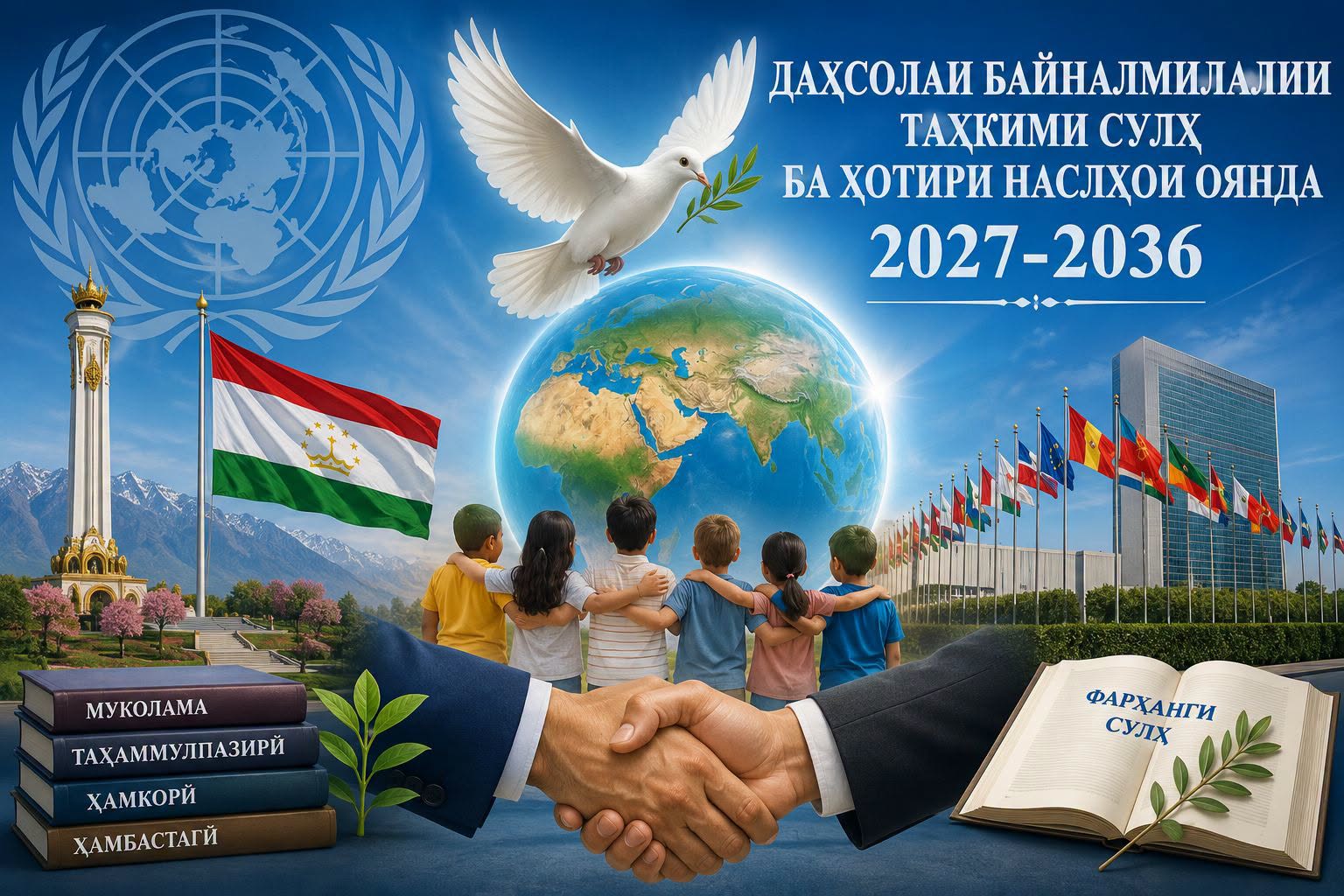
Against this backdrop, the initiative of the Republic of Tajikistan to proclaim 2027–2036 as the "International Decade for Peace Affirmation for Future Generations," adopted by the United Nations General Assembly, carries significant political and international importance. The adoption of this resolution further reinforces Tajikistan's position as a proactive and responsible contributor to global peace and international security.
Since gaining independence, the Republic of Tajikistan has pursued a foreign policy based on the principles of cooperation, mutual respect, sovereign equality, and the peaceful settlement of international disputes. Through its globally recognized initiatives on water resources, sustainable development, and glacier preservation, Tajikistan has established itself as an active, responsible, and constructive member of the international community.
The new peace initiative represents a logical continuation of this foreign policy. Its primary objective is to unite the efforts of states, international organizations, academic institutions, and civil society in promoting sustainable peace, preventing conflicts, and ensuring a secure future for humanity.
The International Decade for Peace Affirmation for Future Generations provides a favorable framework for promoting a culture of peace, preventing conflicts through dialogue, strengthening tolerance, encouraging youth participation in peacebuilding processes, and fostering intergenerational cooperation. At the same time, it encourages governments to adopt policies that take into account the interests and well-being of future generations.
Tajikistan's experience in restoring peace and national unity serves as an important example for the international community. Following the civil war, the country successfully achieved lasting peace and stability through political dialogue, reconciliation, and mutual understanding. This experience demonstrates that even the most complex conflicts can be resolved through peaceful negotiations and political compromise.
In the contemporary world, peace signifies far more than merely the absence of war. It constitutes the fundamental foundation for economic development, social progress, the protection of human rights and freedoms, the advancement of education and science, and the improvement of people's quality of life. Therefore, fostering a culture of peace should begin within families, educational institutions, the media, and civil society organizations.
Furthermore, Tajikistan's initiative contributes to strengthening regional cooperation. The experience of Central Asia in recent years has demonstrated that, through political will and constructive dialogue, even complex interstate issues can be resolved peacefully. Such cooperation creates favorable conditions for economic growth, the expansion of transport and trade links, and the sustainable management of natural resources.
The adoption of this United Nations General Assembly resolution reflects international recognition of Tajikistan's peace-oriented foreign policy and its valuable contribution to strengthening global peace, security, and international cooperation. The resolution is expected to provide a solid foundation for implementing new international programs, promoting a culture of peace, and enhancing cooperation among nations.
Overall, the "International Decade for Peace Affirmation for Future Generations" is not merely a diplomatic initiative; it is a call for shared responsibility by the entire international community to safeguard peace and promote sustainable development. Only through mutual understanding, tolerance, respect for universal values, and constructive cooperation can a peaceful, secure, and sustainable future be ensured for present and future generations alike.
In this regard, Tajikistan's contribution to advancing this global initiative stands as a model of a peace-oriented, constructive, and responsible foreign policy. It represents a significant step toward strengthening international peace, stability, and security while reaffirming the country's commitment to addressing the most pressing global challenges through dialogue and cooperation.