
ARTIFICIAL INTELLIGENCE — A NEW DIMENSION OF INTERNATIONAL COOPERATION AND TAJIKISTAN’S INITIATIVE AT THE UNITED NATIONS
Amid the rapid development of digital technologies, artificial intelligence has become one of the key drivers transforming modern society. Today, the application of artificial intelligence is no longer limited to the field of information technology; it has expanded into science, education, healthcare, the economy, agriculture, energy, public administration, and many other areas of social life. Therefore, the effective, safe, responsible, and equitable use of artificial intelligence technologies has become one of the important issues on the international agenda.
In this context, initiatives by developing countries aimed at strengthening international cooperation in the field of artificial intelligence are gaining particular significance. Recognizing the importance of modern technologies and their role in ensuring sustainable development, the Republic of Tajikistan has taken an active position in this process. One important example of such an initiative was the proposal put forward by the President of the Republic of Tajikistan, His Excellency Emomali Rahmon, at the 79th session of the United Nations General Assembly.
On 24 September 2024, during the General Debate of the 79th session of the United Nations General Assembly, the President of the Republic of Tajikistan, His Excellency Emomali Rahmon, proposed the adoption of a special resolution on the role of artificial intelligence in creating new opportunities for socio-economic development and accelerating the implementation of the Sustainable Development Goals in Central Asia.
This initiative was introduced at an important stage in the development of digital technologies and subsequently received support from the international community.
ADOPTION OF THE UN RESOLUTION AND THE SIGNIFICANCE OF TAJIKISTAN’S INITIATIVE
On 25 July 2025, the United Nations General Assembly adopted Resolution A/RES/79/322, entitled “The Role of Artificial Intelligence in Creating New Opportunities for Sustainable Development in Central Asia.” The resolution was initiated by the Republic of Tajikistan in cooperation with the Central Asian countries — the Republic of Kazakhstan, the Kyrgyz Republic, Turkmenistan, and the Republic of Uzbekistan — and was adopted without a vote.
The adoption of such an international document is of considerable significance, as it moves the issue of artificial intelligence beyond the framework of individual national policies and brings it to the level of regional and international cooperation. The resolution emphasizes the need to strengthen international cooperation to enhance countries’ capacities in artificial intelligence, develop educational and training programmes, build professional expertise, and improve access to open artificial intelligence models and computing resources.
A key aspect of Tajikistan’s initiative is that artificial intelligence is viewed not as an end in itself, but as an important instrument for achieving the Sustainable Development Goals. In other words, technology should contribute to improving people’s quality of life, promoting economic development, expanding educational opportunities, advancing science, increasing the efficiency of public administration, and addressing social challenges.
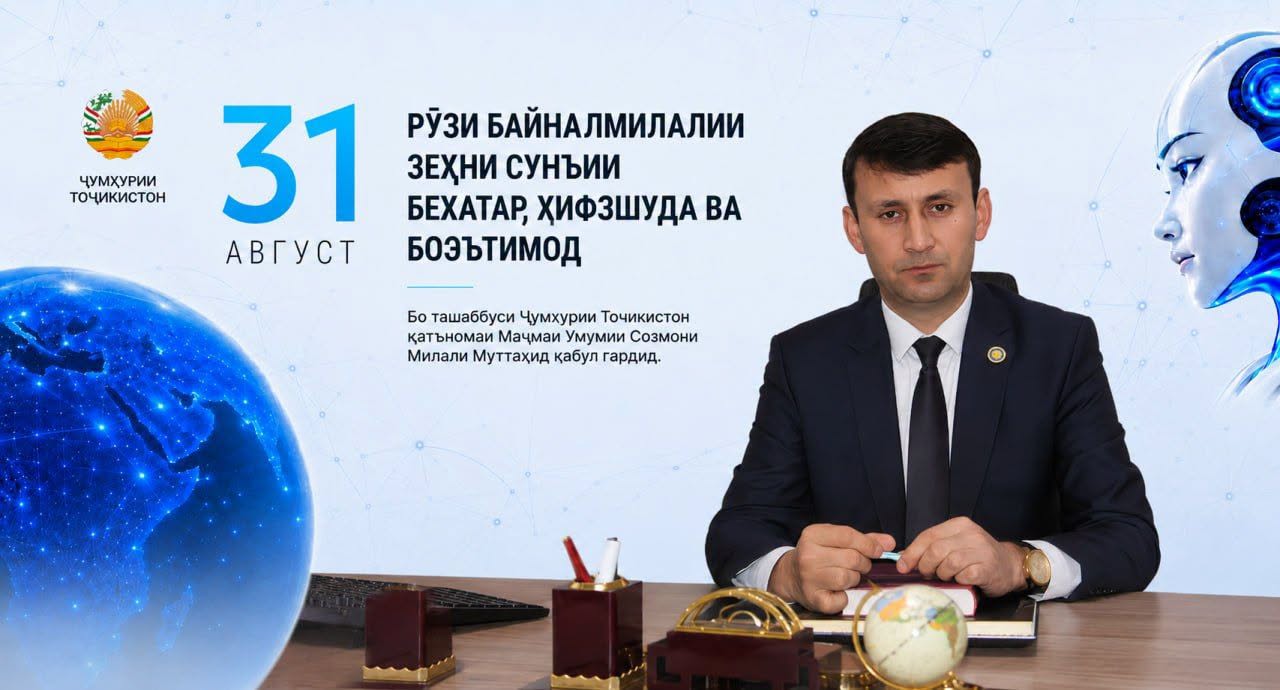
In this regard, another proposal by the President of the Republic of Tajikistan, His Excellency Emomali Rahmon, to proclaim 31 August as the International Day of Artificial Intelligence also received support from the international community. Against the backdrop of the rapid development of digital technologies and the growing role of artificial intelligence in the economic, social, scientific, and cultural life of modern society, this initiative has acquired particular significance.
The establishment of such an international day can provide a favorable platform for drawing the attention of the global community to the opportunities and prospects offered by artificial intelligence, as well as to issues related to its responsible, safe, and equitable use.
The significance of this initiative lies primarily in the fact that artificial intelligence, as a major technological phenomenon, is directly connected with a wide range of issues related to sustainable development, scientific progress, improvement of education systems, development of the digital economy, and enhancement of social services. Therefore, establishing an international day dedicated to artificial intelligence can contribute to fostering a culture of responsible use of emerging technologies and improving digital literacy among the population.
Against this background, the initiatives of the Republic of Tajikistan aimed at developing international cooperation in artificial intelligence are gaining strategic importance. By raising issues related to modern technologies at the United Nations level, Tajikistan seeks to draw the attention of the international community to the need to harness scientific and technological progress for the benefit of sustainable development.
Overall, such initiatives can be regarded as an important step toward raising the profile of technological issues on the international agenda. They can contribute to strengthening scientific cooperation, facilitating the exchange of experience and knowledge, developing human capacity, and creating favorable conditions for the use of artificial intelligence achievements for the benefit of humanity.
From this perspective, the initiatives of the Republic of Tajikistan in this field are significant not only technologically, but also scientifically, socially, and culturally. These efforts can contribute to shaping a new societal approach to artificial intelligence technologies, encouraging the rational and responsible use of their capabilities, and creating a foundation for the sustainable development of society.
Taking into account global trends in the development of digital technologies, it can be stated that Tajikistan’s initiatives in the field of artificial intelligence reflect the country’s forward-looking policy and the State’s serious attention to science and technology. The presentation of such initiatives at the United Nations once again demonstrates that the Republic of Tajikistan, as an active and initiative-driven member of the international community, is making a meaningful contribution to addressing important global issues.
Today, artificial intelligence is no longer merely a technological achievement; it has become an important instrument for shaping the society of the future. Therefore, international cooperation, responsible use, and ensuring equitable access to the opportunities offered by artificial intelligence can play a significant role in achieving sustainable progress and improving the well-being of humanity.
Sobir Isozoda
Vice-Rector for Science and Digital Development
University of Innovation and Digital Technologies of Tajikistan