
TAJIKISTAN ON THE GLOBAL MAP OF ARTIFICIAL INTELLIGENCE
In the 21st century, a country’s position in the international arena is determined not only by its territory, natural resources, or economic capacity, but also by the level of scientific and technological development, human capital, and its ability to make effective use of modern innovations. In this context, artificial intelligence (AI) has become one of the most powerful forces transforming the modern world, with a growing impact on the economy, education, healthcare, energy, agriculture, public administration, and many other areas of society.
Under these circumstances, an important question arises: What place does Tajikistan occupy on the global map of artificial intelligence, and how can it contribute to shaping the technological future of the region and the world?
The answer to this question can primarily be found in the forward-looking policies of the country’s leadership and the international initiatives of the Republic of Tajikistan. The adoption of the Strategy for the Development of Artificial Intelligence in the Republic of Tajikistan for the Period up to 2040 demonstrates that the development of AI has become one of the important directions of the country’s strategic state policy.
The Founder of Peace and National Unity — Leader of the Nation, President of the Republic of Tajikistan, His Excellency Emomali Rahmon, pays particular attention to the development of science, modern technologies, innovation, and the digital economy. Within the framework of this policy, artificial intelligence is regarded as one of the most promising areas for advancing the digital economy, increasing the efficiency of various sectors, and strengthening the country’s competitiveness.
Another important step has been the inclusion of Tajikistan’s initiatives in the international agenda on artificial intelligence. The adoption in 2025 of a United Nations General Assembly resolution concerning the role of artificial intelligence in creating new opportunities for sustainable development in Central Asia demonstrated that the Republic of Tajikistan can act as an initiator of discussions on important technological issues at the international level.
The year 2026, however, has acquired particular significance for the continuation of this process.
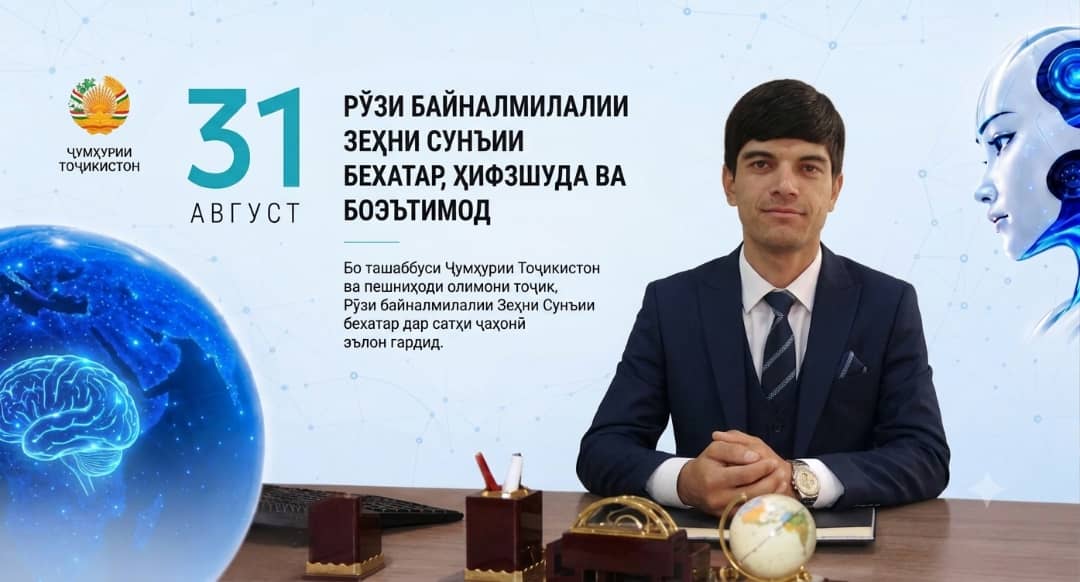
The recognition of 31 August as the International Day of Artificial Intelligence represents an important milestone in shaping the global AI agenda. For Tajikistan, this date is of particular importance, as it is directly connected with the country’s initiatives and its active position in international discussions concerning the development of artificial intelligence.
On the occasion of this historic event, we sincerely congratulate the Founder of Peace and National Unity — Leader of the Nation, President of the Republic of Tajikistan, His Excellency Emomali Rahmon, and the entire noble people of Tajikistan.
The significance of this day is not limited merely to the introduction of a new date into the international calendar. Above all, it demonstrates that artificial intelligence has become one of the key issues on the global agenda and that the international community increasingly recognizes the need for the responsible development of technology, stronger international cooperation, adherence to ethical principles, and the use of AI for the benefit of humanity and society.
At the same time, this achievement brings new responsibilities for Tajikistan. The country’s actual position on the global AI map cannot be determined solely by the adoption of strategies and regulatory documents or by the organization of international events. The true measure of progress is the country’s ability to generate knowledge, train highly qualified specialists, develop scientific schools, create national technologies, and produce competitive digital products.
In this regard, young people, knowledge, science, and human intellectual potential constitute Tajikistan’s most valuable resources. Higher education institutions should gradually become active centers for the development of science, innovation, and artificial intelligence technologies.
Training AI engineers, programmers, data analysts, machine learning researchers, cybersecurity specialists, and other professionals who meet the requirements of the digital economy should become one of the priority areas for the development of education and science in the country.
At the same time, the development of artificial intelligence should focus not only on training specialists but also on addressing the country’s real economic and social challenges. The application of AI technologies in education, healthcare, agriculture, industry, energy, public services, and resource management can contribute to greater efficiency, lower costs, and improved quality of services.
Today, Tajikistan stands at the threshold of a new stage of technological development. At this stage, the country should establish a sustainable position on the global map of artificial intelligence not merely as a user of foreign technologies, but as a state with competitive specialists, a strong scientific foundation, national digital products, and meaningful international initiatives.
From this perspective, 31 August 2026 is not only a historic date for us but also the beginning of a new stage of responsibility. Responsibility toward future generations requires us to direct the opportunities offered by artificial intelligence toward the country’s genuine development, scientific progress, improvement of the quality of education, growth of the national economy, and enhancement of the quality of life of the population.
Thus, Tajikistan’s place on the global map of artificial intelligence is determined not only by its geographical position or economic potential, but primarily by the level of development of science and education, human capital, technological capacity, and the country’s international initiatives.
The recognition of 31 August as the International Day of Artificial Intelligence is not only an important achievement for Tajikistan but also creates new responsibilities. At this stage, building on the forward-looking policy of the Founder of Peace and National Unity — Leader of the Nation, President of the Republic of Tajikistan, His Excellency Emomali Rahmon, it is essential to direct the potential of artificial intelligence toward the advancement of science and technology, the training of competitive specialists, the digital transformation of economic and social sectors, and the improvement of people’s quality of life.
Only through such efforts can Tajikistan move from being primarily a user of modern technologies to becoming an active participant in their creation and development, while making a meaningful contribution to shaping the technological future of Central Asia and the global community.
Davroni Bozorali
Assistant, Department of Programming Technologies
University of Innovation and Digital Technologies of Tajikistan